
News
Embraer secures India’s Type Certification for E-Jets
July 9th 2026
Embraer said its family of E-Jets has received Type Certification from India’s Directorate General of Civil Aviation (DGCA). Read More » The certification covers multiple aircraft from the E-Jets family, including the E190, E195, and E195-E2. The E175 is already type-certified for India and is operated by Star Air. “We welcome the type certification of Embraer’s aircraft and thank the DGCA for its thorough assessment. With remarkable performance, economics, and passenger comfort, Embraer’s E-Jets are set to reshape regional aviation in India and support the Indian government’s UDAN vision,” said Raul Villaron, Senior Vice President Sales & Marketing, Head of Region Asia Pacific, Embraer Commercial Aviation.
India’s aviation market is of great importance to Brazilian OEMs. In February 2026, Adani Defense & Aerospace and Embraer announced an enhanced Memorandum of Understanding (MoU) to establish a Final Assembly Line (FAL) for the E175 regional jet, aligned with India’s Regional Transport Aircraft (RTA) program.
Embraer is very interested in India’s airline industry development, as it believes the country needs many regional connections that the E-Jet family can serve. “The E-Jets offer an enhanced range of up to 7 hours and performance capabilities to operate from challenging airports with short runways or low pavement strength. This certification enables us to support airlines expanding their networks and opening unique routes by tapping into ‘blue ocean’ opportunities that are too small for a large narrowbody or too far for a turboprop,” said Adity Shekhar, Regional Vice President, Sales, Embraer.
During the IATA Embraer Experience Day 2026 on June 9, 2026, Arjan Meijer, president and CEO of the Commercial Aviation unit, told Orient Aviation Daily Digest (OADD) that his company sees the niche in the market between turboprops and large narrowbodies operations as a field in which it can deliver value to operators in the Asia-Pacific region.
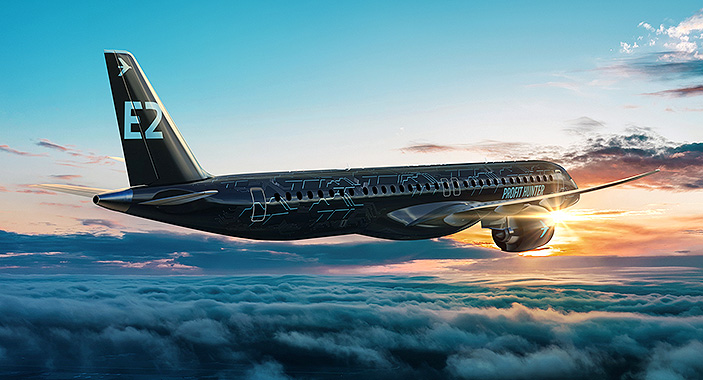
“We are looking at turboprop operations. We still have many turboprop routes where the E2 could be a very good replacement aircraft. So that’s one area,” Meijer told OADD. “We can help with more frequent frequencies to small destinations, so more detailed development,” he added, pointing out to Scoot as an airline following this route with 22 destinations, half of which are new, operated with E2 jets. “We really believe it’s the tool Asia can use to build a connection to smaller cities, and it is hugely complementary to Airbus A320 and A321 size,” Meijer explained. “There has always been a lot of focus in Asia on seat cost. We believe in a world that is more challenging, whether it is fuel price or airport cost, airlines will also have to look at which aircraft has the most optimal operating cost. And the 195 E2 offers 25% lower trip cost than the A320. OK, you get fewer seats. But the cost per seat is still the same. So you can have more seats when no one is sitting on a seat, or when someone is sitting on a seat who is not even paying for that seat. You’d better find a smaller aircraft. That’s why we call it Profit Hunter,” Meijer said. “Across these three lines- turboprop advancements, smaller destinations roll, and complementing narrow-bodies with much smarter aircraft- we believe we have a proposition that works in Asia,” he concluded.
The next-generation E195-E2 was triple certified by three key civil aviation authorities – the FAA (USA), EASA (Europe) and ANAC (Brazil) in 2018 and 2019, respectively, Embraer said.

