
News
Singapore Airlines Group posts record interim revenue
November 12th 2026
Singapore Airlines (SIA) Group reported a 16.8% rise in its FY2026/27 half-year revenue to a record S$11.3 billion ($8.82 billion), and a net profit of S$134 million, down from S$239 million a year ago. Read More » The results were boosted by record passenger volumes, higher airfares and robust cargo demand.
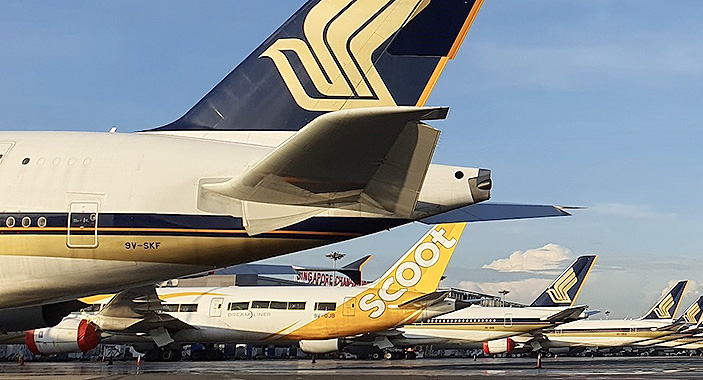
SIA and Scoot flew a half-year record of 21.8 million passengers, up 5.0% year-on-year. Group passenger load factor (PLF) was 86.8%, up 0.9 ppt, as capacity expansion of 4.9% outpaced traffic growth of 3.8%. Cargo revenue grew by 30.2% (+$323 million) to S$1,394 million, driven by a 25.4% improvement in yields and a 2.0-percentage-point increase in the cargo load factor (CLF) to 58.5%.
SIA’s expenses rose more than 20% to S$10.73 billion, largely due to a surge of over 90% in fuel costs before hedging. "An extended conflict could also have spillover effects on broader macroeconomic conditions, potentially leading to further inflationary cost pressure and affecting demand for passenger travel and air freight,” SIA said.
In the second quarter, Group operating profit rose by S$65 million (+16.3%) year-on-year to S$463 million, underpinned by the Group’s record second-quarter revenue of $5.6 billion (+S$698 million; +14.3%). Passenger flown revenue increased 15.0% to S$4.5 billion, supported by 12.2% yield growth and 2.3% higher passenger carriage. Cargo revenue grew 26.9% to S$686 million, with cargo yields up 22.3% and loads up 3.9%.
Looking ahead, SIA said it is expecting positive passenger and cargo demand. “Passenger demand remains healthy, supported by seasonal travel flows. Cargo demand has been firm, driven by semiconductor and cloud computing-related flows, as well as shipments shifting to air freight amid geopolitical and weather-related disruptions to maritime shipping,” the company said.
“The airline industry operates in an uncertain environment, with volatile geopolitical developments, including the conflict in the Middle East, adding complexity across operations and supply chains. Jet fuel prices remain elevated relative to pre-conflict levels, and continue to place significant pressure on costs. While the Group has adjusted air fares and cargo rates, these measures do not fully offset the impact of sustained high fuel prices,” SIA noted. “The Group is in a strong position to navigate this volatility. Its diversified global network and broad mix of traffic flows help to cushion shifts in demand, while the complementary positioning of Singapore Airlines and Scoot enables them to serve different markets and customer segments, and adjust capacity and schedules with agility, as the Group has consistently demonstrated,” it added.

