
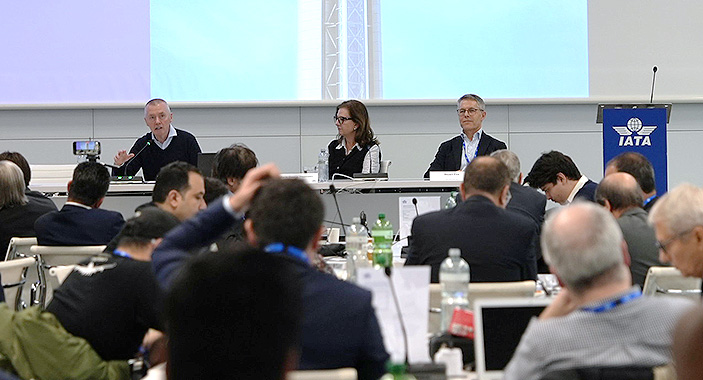
IATA Global Media Day 2025 Report
IATA persuaded Asia-Pacific airlines could improve their margins
December 11th 2025
The International Air Transport Association (IATA) has released its latest financial outlook for the global industry, forecasting a net profit margin for Asia-Pacific airlines of US$3.30 per passenger, the second lowest of the six regions worldwide the global association monitors and below the global average of $7.90 per passenger. Read More » Willie Walsh, IATA’s director general, told Orient Aviation Daily Digest he would like to think Asia-Pacific airlines could improve their profit margins. Showing the direction to follow to reach this goal he highlighted the Middle East market, whose carriers will book a net profit per passenger of 9.3% in 2025 ($28.90) and $28.60 in 2026. "The Middle East is unique in in that it almost does not have a domestic market. Around 98% of the region’s traffic is international. A lot of that is long-haul international and a lot of long-haul international is premium so it has all the ingredients that point to higher margins. Long-haul is typically more profitable than short-haul and premium is typically more profitable than non-premium. Therefore, if you look at the Middle East, it should not surprise you that the profit is where it is," Walsh said. "The Asia-Pacific has some opportunities there. I think focusing on international expansion, on premium, because the region always has been seen as a premium destination. Premium does not have to mean expensive, but premium is something that consumers demand. They want to have a premium experience. We have been seeing it more and more and this is the opportunity for carriers in the Asia-Pacific," Walsh said.
"There also is a big domestic market in the region and domestic markets tend to be much more challenging from a profitability point of view."
Airlines may drop 2030 net zero target as SAF production falls short of demand
The International Air Transport Association (IATA) director general, Willie Walsh, is disappointed with progress in producing more Sustainable Aviation Fuel (SAF).
"SAF demand continues to be strong, but we are not seeing SAF produced in the volumes we want," he told attendees at the IATA Global Media Day held this week in Geneva. "Between 2024 and 2025, production of SAF doubled, but between 2025 and 2026 it will not double, even though we expected SAF production to grow exponentially," Marie Owens Thomsen, IATA senior vice president for sustainability and chief economist, said. "This leads to a situation in which airlines that committed to a high amount of SAF used by 2030 might be forced to reevaluate the targets. "Personally, I think these numbers will be impossible to achieve through no fault of their own," Walsh said, citing Air New Zealand as an example of the current shortfall in SAF supply. "Additionally, especially in Europe, "SAF production growth fell short of expectations as poorly designed mandates stalled momentum in the fledgling SAF industry. If the goal of SAF mandates was to slow progress and increase prices, policymakers knocked it out of the park. But if the objective is to increase SAF production to further the decarbonization of aviation, then they need to learn from failure and work with the airline industry to design incentives that will work," said Walsh. IATA cautioned that as e-SAF mandates approached in the UK (2028) and EU (2030), it is essential not to repeat the policy missteps seen with SAF.
"Already, e-SAF faces a much higher cost base, potentially up to 12 times that of conventional jet fuel. Without strong production incentives as opposed to mandates, supply will fall short of targets. Given the low SAF production volumes, it is evident current policies are not having the desired effect.
"Faced with such facts, regulators must course correct, ensure the long-term viability of SAF production and achieve scale so that costs can come down. Mandates have done just the opposite. It is outrageous to repeat the same mistakes with e-SAF mandates," Owen Thomsen said.
Global airline association highlights importance of fast cargo in fragmented world
A fragmented world needs fast cargo, which is shifting as quickly as trade lanes shift, Brendan Sullivan, IATA global head of cargo, told media at the IATA Global Media Day. In the market reality of the highest U.S. tariffs in almost 100 years, air cargo played an important role in global trade to adjust to the new situation. Julia Seiermann, head of industry analysis at IATA, said tariffs prompted a major shift in global trade such as Chinese exports and air cargo allowed the rapid change of trade flows in 2025. For example, Far East-Europe traffic more than offsets the weak Far East-North America lane. "Insuring we have strong cargo is necessary," Sullivan said. Air cargo continues to grow, reaching an all-time high in October 2025. In 2026, global cargo traffic is expected to stabilize at 2.6%, IATA forecasts.

