
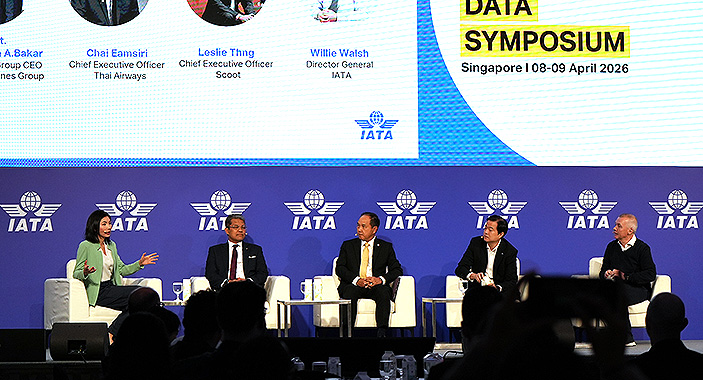
IATA World Data Symposium Day 1
Airline industry declares readiness for contactless travel
April 9th 2026
The International Air Transport Association (IATA) published the results of several digital identity Proofs of Concept (PoCs) completed with the support of airlines, airports, technology providers, and governments across Europe and Asia-Pacific. Read More » Published during the IATA World Data Symposium (WDS) in Singapore, the results of PoCs demonstrated that contactless, biometric-enabled international travel is already achievable, with digital identity replacing paper documentation. The PoCs used an approach in which a traveler’s passport data is securely captured from the physical document, stored in a mobile wallet, and linked to the traveler via biometric verification. Working together as part of the IATA Strategic Partnership Program, the partners tested how digital identity stored in mobile wallets and biometric verification can support seamless passenger journeys without repeated paper document checks. “We have proven that digital identity for international travel works securely and efficiently. For travelers to benefit from this important modernization, governments must accelerate efforts to issue and accept Digital Travel Credentials (DTCs)—secure digital versions of passports. The result will be stronger security, smoother journeys, and greater efficiency,” said Willie Walsh, IATA’s Director General. The Association said that making this into a traveling standard will require coordinated action by governments in three critical areas: Establishing the legal, operational and technical foundations to issue Digital Travel Credentials (DTCs)—secure digital versions of passports—as part of national digital identity programs, ensuring border, visa and travel-authorization systems are ready to accept and verify DTCs issued by other states, and working with industry, other governments and international organizations to enable the interoperable use of DTCs at a global scale. “Secure digital versions of passports—Digital Travel Credentials (DTCs)—will make travel more secure and more efficient. By sharing identity data in advance, checks can be completed earlier, reducing the need for document checks at airports and cutting queues. Industry collaboration has shown that digital identity works in practice. The next step is for governments to put the frameworks in place to integrate digital identity into global travel processes,” said Walsh.
Airline leaders say artificial intelligence is not to replace people
The goal of implementing artificial intelligence (AI) in the airline industry is not to replace the workforce. On the contrary, employee engagement is critical to realizing digital transformation, said industry leaders at the International Air Transport Association (IATA) World Data Symposium (WDS). Addressing the WDS delegates, Kim Macaulay, Chief Information and Data Officer at IATA, said we need to be united in the drive to introduce AI. She pointed to Singapore, the host of the ongoing WDS, as the country pioneering the concept of “Smart Nation” as an example for the airline industry, which is at the forefront of data. The idea that the people’s engagement is fundamental for the introduction of AI was shared by Goh Choon Phong, CEO of Singapore Airlines (SIA). Based on the airline’s decade long process of digital transformation, Goh shared four points foundation for employing the AI: Creating digital mindset within the airline, making sure that the organization has not jas a proper infrastructure to carry on the change, identifing the call for change, mindset required by the organization, and recognizing, that this is the process that airline cannot do alone, without help of start ups or research institutions. Heejung Choi, CIO Korean Air (KAL) described AI as responsible democratization of the airline, cautioning that people need to be in the centre of the process of moving towards the AI. “Technology democratization succeeds when every employee - not just IT - becomes a participant in the AI journey. Empower people first,” she said, adding that the goal of the AI is not to replace people, but to allow them to concentrate on fulfilling activities, such as providing the best hospitality to the passengers, without the burden of taking on other tasks. “Do not use AI to replace people, use it to augment them,” she concluded.
Airlines have no other choice but to continue to invest in digital transformation, says IATA boss
“COVID-19 pandemic experience shows us that we have no other choice but to continue to invest,” said Willie Walsh, International Air Transport Association’s (IATA) Director General, discussing the challenge of digital transformation during the IATA World Data Symposium (WDS) in Singapore. According to Walsh, digital transformation allowed the industry to cope with the growing number of passengers. One of the fundamental examples of this was the introduction of online check-in outside the airport, which created a win-win situation for passengers and airlines, said the IATA boss. For Scoot, an airline operating under a low-cost carrier (LCC) model, where margins are lower, the use of AI is viewed as a way to improve long-term competitiveness, said Leslie Thng, Scoot’s CEO. “We believe AI will increase customer engagement and optimize productivity related to aircraft and crew,” he said, highlighting that the most pressing question is how to access the existing data to achieve this goal. Thai Airways CEO Chai Eamsiri said the airline feels the impact of the Middle East crisis. “At this moment, we do not talk about profitability. We talk about how to survive. We have to tighten the belt,” he said. Despite this, Thailand’s flag carrier will not abandon the digital transformation. “Many others are cutting this. We keep AI and other projects. Our first priority is customer experience,” said Chai, explaining that the airline needs data to provide to customers’ individual needs. The digital transformation will not stop at Malaysia Airlines (MAS), declared Captain Nasaruddin A. Bakar, President and Group Chief Executive Officer (CEO) of Malaysia Aviation Group (MAG). “We need to continue to plan for the long run. Invest in people and technology,” he said, adding that the company’s experience, including the twin tragedies, makes it most focused on the aspect of safety, including cybersecurity.

