
News
Global air cargo demand fell in March after rising for over two years, Asian carriers saw growth
April 30th 2026
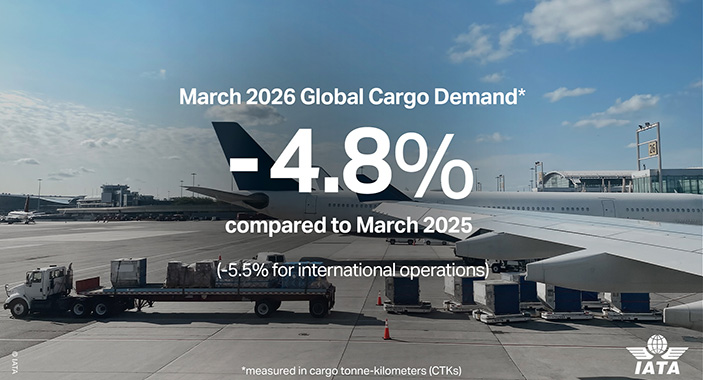
The International Air Transport Association (IATA) released data for March 2026 global air cargo markets showing that the total demand, measured in cargo tonne-kilometers (CTK), fell by 4.8% compared to March 2025 levels (-5.5% for international operations). Read More » Capacity, measured in available cargo tonne-kilometers (ACTK), decreased by 4.7% compared to March 2025 (-6.8% for international operations). “Air cargo demand fell 4.8% in March compared to the previous year. This was mostly due to severe disruptions at major Gulf hubs due to war in the Middle East. The timing of the usual post–Lunar New Year slowdown also added to the decline,” said Willie Walsh, IATA’s Director General.
Asia-Pacific airlines saw a 5.4% year-on-year growth in air cargo demand in March. Capacity increased by 5.0% year-on-year. Middle Eastern carriers saw a 54.3% year-on-year decrease in air cargo demand in March, the weakest performance among all regions. Capacity decreased by 52.4% year-on-year.
Air cargo performance diverged across major trade lanes in March. Africa-Asia led growth (+22.6%) followed by Asia–Europe (+14.2%), with intra-Asia also holding strong on regional trade (+7.5%). In contrast, Gulf-linked corridors were severely disrupted by the ongoing conflict in the Middle East. The Asia-Europe lane enjoyed 37 consecutive months of growth.
“The underlying demand trends, at this point, appear strong, and the recent World Trade Organization and International Monetary Fund revisions to trade and GDP projections continue to see growth in 2026. Importantly, air cargo networks are providing the flexibility needed to support global supply chains as they adjust to geopolitical, tariff, and operational strains. All eyes are on fuel supply and price, which are expected to test the industry’s resilience in the coming months,” Walsh said.

