
News
Asian carriers achieve double-digit increase in international passenger demand in March, according to the latest data published by global airline association
April 30th 2026
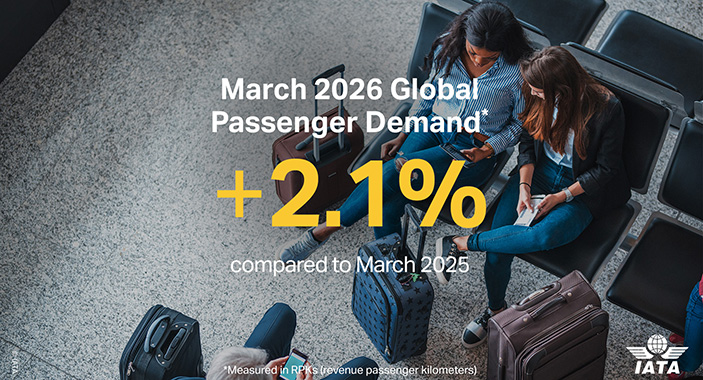
The International Air Transport Association (IATA) released data on global passenger demand for March 2026. Read More » In the first month after the start of the Middle Eastern conflict, which is currently heavily affecting the environment in which airlines operate, total demand, measured in revenue passenger kilometers (RPK), was up 2.1% from March 2025. Total capacity, measured in available seat kilometers (ASK), decreased 1.7% year-on-year. The load factor was 83.6% (+3.1 ppt compared to March 2025). International demand fell 0.6% compared to March 2025. Capacity was down 6.2% year-on-year, and the load factor was 84.1% (+4.7 ppt vs. March 2025). The overall decline in international traffic was driven by a 60.8% fall in traffic from carriers in the Middle East. “Demand for air travel continued to grow in March despite disruptions in the Middle East. The nearly 61% decline in international traffic by carriers in the Middle East did, however, restrain global growth to 2.1%. Outside of the Middle East, demand grew by 8%,” said Willie Walsh, IATA’s Director General, highlighting the fragmentation of the markets.
In the international passenger market, Asia-Pacific airlines achieved an 11.5% year-on-year increase in demand. Capacity increased 1.5% year-on-year, and the load factor was 91.2% (+8.1 ppt compared to March 2025). Traffic in the region was boosted by the tail end of the Lunar New Year travel period, and international routes (with the exception of routes to the Middle East) enjoyed double-digit expansion, the IATA said.
Middle Eastern carriers saw a 60.8% year-on-year decrease in demand. Capacity decreased 56.9% year-on-year, and the load factor was 67.8% (-6.6 ppt compared to March 2025). These figures are a direct result of the US-Israel-Iran war, which closed much of the airspace in the region.
“Everybody’s watching what’s happening with jet fuel—both supply and pricing. On the supply side, over the next months we could see shortages in parts of the world with high dependence on supplies from the Gulf, especially Asia and Europe. And the extraordinarily high cost of jet fuel is increasingly being reflected in ticket prices. While this has not impacted March traffic or forward bookings to date, it remains to be seen at what point high prices could start to shift passenger behavior. So far, the summer is shaping up to be a normally busy time for travel. That’s positive news, but airline resilience is being tested, and stabilizing the supply and price of fuel is crucial. In the meantime, it’s important for regulators to be prepared to grant airlines some flexibility on slots, considering the extraordinary circumstances of airspace capacity restrictions and potential fuel rationing,” said Walsh.

