
Orient Aviation Daily Digest Guest
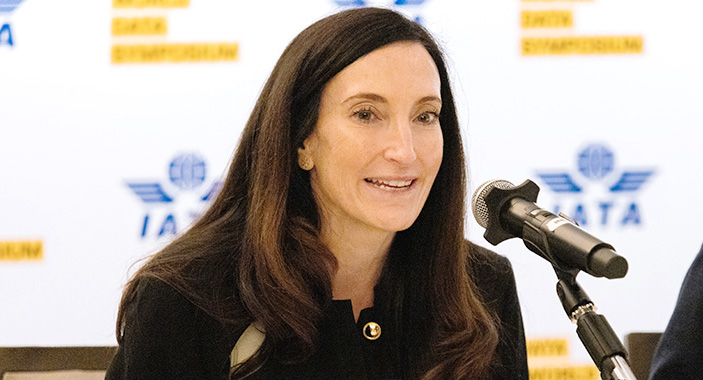
“You should definitely not be afraid of AI” says Orient Aviation Daily Digest guest Kim Macaulay (IATA)
April 30th 2026
Passengers’ survey showing important demographic shift, and examples of other industries make it clear - the airline industry needs to pursue digital transformation, and safeguard the customer’s and airlines data, Kim Macaulay, Chief Information and Data Officer and International Air Transport Association (IATA), told Orient Aviation Daily Digest (OADD) in the interview on sidelines of Association’s World Data Symposium (WDS). Read More » The second edition of this one of IATA’s most important events was held earlier this month in Singapore.
OADD: As we meet during the second day of the IATA World Data Symposium (WDS), what is the airline’s industry progress realizing the digital transformation? What have we achieved as an industry, what is the target?
Kim Macaulay: We have made massive progress over the last three years, but we are still not where we should be. One of the major opportunities around digital transformation is around the modern airline retailing space. Another opportunity is contactless travel and digital identity. We saw an example of the opportunity first hand on stage where Air New Zealand presented the work and progress with the New Zealand Border Control, and governments. Contactless travel and digital identity is a great example of topics that affect the entire industry and Air New Zealand showed what can be achieved when stakeholders work together.
On the IT side, the move to cloud environments, data warehouses, data lakes and opening up data further enables digital transformation. My ambition over the past few years was leading the move towards data, owning the data, airlines being the ones more in control of data, and realizing that you can only transform and digitize with data. So if you don’t have access to it, you won’t be able to transform.
The IATA customer satisfaction survey shows that the Asia-Pacific customers are the most willing to use the new technologies, and they are tech-savvy. Would you say it is the same case with the region’s airlines?
I would say yes, because they are being pushed by the customers. Customers have a lot of choice; the more choice you give them, the more they want, and the quicker they want things. Certainly Asia has always been remarkable in terms of automation and the use and adoption of different technologies. For IATA, it is important that we are aware of what is happening in different regions. For example, in China, you cannot access many applications and software like OpenAI, Google, Facebook, or Instagram. This impacts the way we do business, so it is important that we are aware of what is happening in the technology space – globally. Asia is certainly advanced in technology we can see it here in Singapore, where there is massive infrastructure and technology advancement all around us. Everything simply works. If we look at the airport as an example, they are embracing technology to make it fit for purpose for passengers.
So, do you think Asia can be a good example for other regions?
Asia is definitely a good example. As a South African, we always look to Asia as an example because if Asia can do it, so can Africa. We can learn things like: what’s the technology? How do they embrace it? How do they utilize it? What are they doing around customer importance? But also, if I look at Asia, the governments and key stakeholders are really committed to technology. and vested in using the technology to improve customer service.
A big part of the discussion at this year’s event is AI. It is a very hot topic, also outside the industry. Even during the event, in the Data and Technology track, we heard it is a great opportunity, while in the Cybersecurity track, the panelists often emphasized the risks. So, should we be afraid of AI?
No! You should definitely not be afraid of AI, but you have to use AI for what it is intended to be used for. You also need to choose the right use cases; you cannot just throw AI at everything, it is just not going to work. Back in my banking days, it was always around bitcoin, and it was like, “Oh, let’s put everything on blockchain.” As we have learned, not everything works on blockchain, and not everything works on AI. Still, I would not be scared of AI. The WDS was deliberately structured with the intention of connecting cybersecurity into the data and technology. Clearly there will be some pushback from cybersecurity voices because they want to create an environment that maintains and looks at the risks; they are not going to jump into things. However, there is a point where the two intersect and cybersecurity experts and leaders will have to join in this AI this journey to innovate. You cannot innovate without taking some risks. So it is happening, and we just need to see how we get on board with it, how we manage the risk, how we pick the right use cases, and how we make sure we actually deliver value with AI. It is not a tool that fits everyone, or fits every use case.
Just to emphasize, there is no way for the airlines to decide, “let’s stay out of the AI, let’s wait and see what it will look like in the future”?
Definitely not, it is just a matter of time. The IATA passenger survey shows there are more and more younger travelers. They are increasingly digital experts and they want instant gratification. They expect a digital process with personalization. They want airlines to provide a seamless experience and understand them as a customer and what they like and expect both on and off the aircraft.
You said AI is not a one-size-fits-all solution. So, what is the best field for AI to be implemented in airline operations?
Clearly AI can be implemented on the customer experience side. It can also be used for pilots and the huge amount of data they must consume. The more you know, the more you can predict, and the more seamless any process will be.
As you mentioned, the second important pillar of the IATA WDS discussion is cybersecurity. What the airline industry needs to understand about this topic, why is it so important?
When you are working with data, you need to keep data secure. You also need to keep the AI model secure and ensure there are no loopholes around any of the large language models, particularly in aviation, safety is paramount. So the connection between cybersecurity and technology is that we want cybersecurity to allow us to innovate, but also we need to safeguard the customer’s and airlines data. From the IT and data perspective, we need to make sure that we are also on par with some other industries, like healthcare, banking, that are also highly regulated. But also look at how we bring security into the application that we deliver to our customers.
How do you see the IATA World Data Symposium evolve in the future?
I’m obviously very biased. I see that this is probably one of IATA’s most important events. WDS is unique in that we are looking across all topics of aviation, since data, technology and cybersecurity touches everything. It will continue to evolve with the key topics in the industry. Also, we will continue to showcase and learn from other industries. Everybody has a similar challenge, everybody has similar struggles. The opportunities can be leveraged, and you can create something really remarkable and special. So keep coming to our WDS.

