
News
Regional airlines association says passenger growth was moderating in April
May 29th 2026
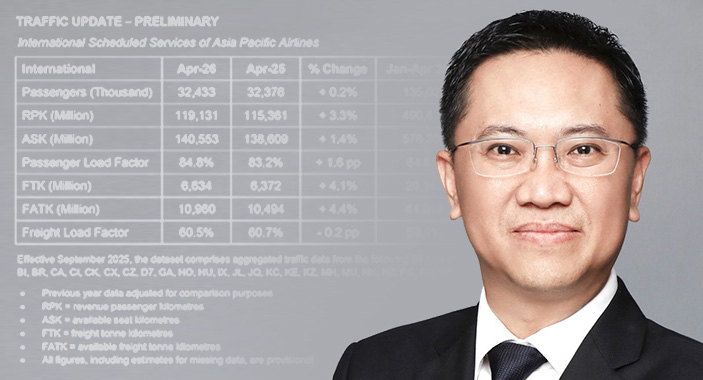
Preliminary April 2026 traffic figures released by the Association of Asia Pacific Airlines (AAPA) showed “stable international passenger demand, with growth moderating amid heightened geopolitical and economic uncertainties.” Read More » Asia Pacific airlines carried 32.4 million international passengers in April, broadly unchanged from the same month last year. Demand (RPK) increased by 3.3% year-on-year, reflecting relatively firmer traffic on longer-haul routes. Capacity (ASK) increased by a marginal 1.4% year-on-year, as growth was restrained by sharply higher fuel costs. International passenger load factors remained high, averaging 84.8% for the month, up by 1.6 percentage points. The conflict in the Middle East led to supply chain disruptions and higher prices, prompting accelerated stockpiling as businesses and consumers sought to secure products ahead of further cost increases. This, in turn, lent support to growth in the air cargo market. International air cargo demand (FTK), increased by 4.1% year-on-year in April. Offered freight capacity expanded by 4.4%, resulting in a 0.2 percentage point decline in the average international freight load factor to 60.5% for the month. “International passenger traffic continued to show resilience in April, supported by sustained demand on longer-haul routes. Overall, Asia Pacific airlines carried a combined total of 135 million international passengers during the first four months of the year, representing a 5.1% increase compared to the corresponding period last year. Meanwhile, the start of the second quarter saw accelerated expansion in global manufacturing activity, with increased purchases of consumer and intermediate goods driving demand for air shipments. Growth in April helped lift international air cargo demand during the first four months of 2026 to 5.3%,” Wong Hong, AAPA Director General, said. “The conflict in the Middle East continues to add volatility to energy markets, keeping jet fuel prices elevated and further intensifying cost pressures for airlines. In April, jet fuel prices rose to an average of US$165 per barrel, reaching levels last seen in 2022 following the onset of the Russia - Ukraine war,” he added. Looking ahead, Mr. Wong Hong said, “Despite signs of the conflict easing, growing macroeconomic uncertainty, coupled with inflationary pressures, continue to weigh on the outlook for both passenger and air cargo markets in the months ahead. Nevertheless, Asia Pacific airlines remain vigilant in managing costs and carefully deploying capacity to optimize yields and profitability in this challenging operating environment, without compromising safety standards.”

