
News
IATA reports weaker passenger demand in Asia in August
October 1st 2026
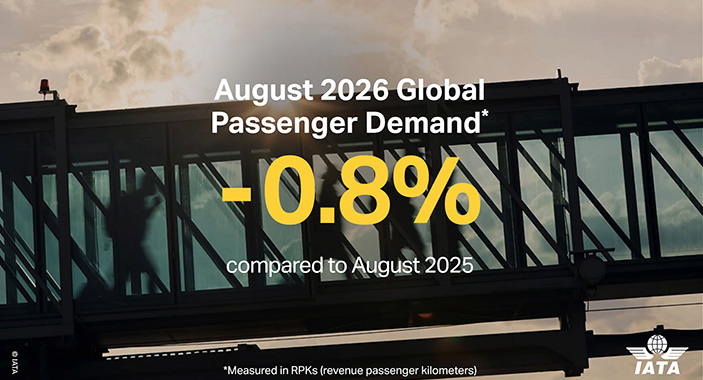
The International Air Transport Association (IATA) released August 2026 global passenger demand data showing total demand, measured in revenue passenger kilometers (RPK), was down 0.8% from August 2025. Read More » Excluding the Middle East, demand grew by 0.6%. Total capacity, measured in available seat kilometers (ASK), increased 0.3% year-on-year. The load factor was 85.1% (-0.9 ppt compared to August 2025). International demand fell 0.9% compared to August 2025. Excluding the Middle East, demand grew by 1.3%. Capacity was flat (0.0%) year-on-year, and the load factor was 85.0% (-0.8 ppt compared to August 2025). Domestic demand fell 0.5% compared to August 2025. Capacity increased 0.7% year-on-year. The load factor was 85.3% (-1.1 ppt during the same reference period).
In the international passenger market segment, Asia-Pacific airlines saw a 0.1% year-on-year decrease in demand. Capacity decreased 0.9% year-on-year, and the load factor was 85.6% (+0.7 ppt compared to August 2025). Traffic on routes within Asia fell 2.0%, and capacity declined for the fourth straight month. By contrast, traffic on the Asia-North America corridor grew by 2.5%.
In the domestic market segment, airlines from Mainland China recorded a 5.8% increase in demand, and in Australia, a 2.3% increase. At the same time, the domestic demand in Japan declined 2.0%, and in India 7.5%.
“Excluding the Middle East carriers, demand for air travel grew by 0.6% year-on-year in August, half the pace seen in July. With some important exceptions such as domestic China, global connectivity was generally weaker in August. The coming months will reveal whether travelers, whose purchasing power has been reduced by higher energy prices, are adjusting their travel budgets, and might be discouraged from traveling due to the prevailing geopolitical instability. In the meantime, forward schedules for October are showing cautious optimism with 2.0% growth in available seats,” said Marie Owens Thomsen, IATA’s Senior Vice President of Sustainability and Chief Economist.

