
News
IATA marks the 10th anniversary of CORSIA with call for governments to support the agreement
October 8th 2026
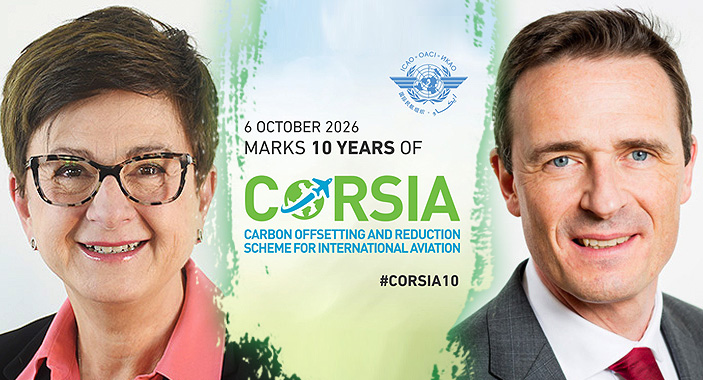
On October 6, 2026, the International Air Transport Association (IATA) marked the tenth anniversary of the International Civil Aviation Organization (ICAO) assembly resolution to establish the Carbon Offsetting and Reduction Scheme for International Aviation (CORSIA) with a call to governments to reinforce the foundations of this landmark step in aviation’s decarbonization. Read More » Adopted at the 2016 ICAO Assembly, CORSIA established the first global market-based measure for an industrial sector and was an important follow-up to the Paris Agreement a year earlier. Today, more than 130 countries participate in CORSIA, and by the end of this year, the scheme is expected to have mitigated approximately 200 million tonnes of CO2. From 2027, CORSIA is expected to cover about 85% of global emissions. Through to the end of the scheme, IATA said up to $120 billion could be mobilized in climate finance to support emissions reduction and carbon removal projects globally.
“As the first global, sector-wide climate agreement for aviation, CORSIA showcases the best of international collaboration: a global solution to a global challenge. It preserves a level playing field for aviation while channeling climate finance to support emissions reductions worldwide. And in a world increasingly characterized by fragmentation, that is a powerful reminder of what can be achieved when states work together. CORSIA is already a landmark achievement. With broad participation, consistent implementation, and continued support from governments, it can become one of the most successful examples of climate action and climate finance in practice,” said Marie Owens Thomsen, IATA’s Senior Vice President Sustainability and Chief Economist.
IATA noted that the tenth anniversary coincides with the European Union’s review of the EU Emissions Trading System (EU ETS). The EU is considering proposals to extend the EU ETS to destinations within 5,000km of the EU (using Frankfurt as its geographic center) and create a mechanism to develop comparable carbon-pricing systems with third countries. “The EU ETS review should reinforce CORSIA as the global framework for international aviation, not encourage overlapping regional or bilateral systems. Europe will achieve more for climate action and its own competitiveness by directing aviation revenues towards Sustainable Aviation Fuels, infrastructure and emerging technologies than by adding carbon costs that do not address the sector’s underlying energy constraints,” said Thomas Reynaert, IATA’s Senior Vice President External Affairs.
The association warned that the lack of an impact assessment on widening the scope of EU ETS does not provide a clear overview of the potential effects on third countries, international connectivity, competitiveness, and the functioning of CORSIA, despite IATA’s estimate that the proposed scope expansion would increase EU ETS compliance costs by 40% to EUR280 billion over the 2027-2040 period.
IATA said the EU ETS review should reinforce CORSIA, support Sustainable Aviation Fuel (SAF) production, and strengthen Europe’s competitiveness by ringfencing aviation-generated ETS revenues for SAF production, infrastructure, and emerging aviation technologies.


Len Gray says:
October 8th 2026 08:22am