
IATA WFS&WPS: News Coverage
IATA inaugurates 2026 edition of its financial and passenger experience held in Macau with “Moving from Vision to Value” focus
October 29th 2026
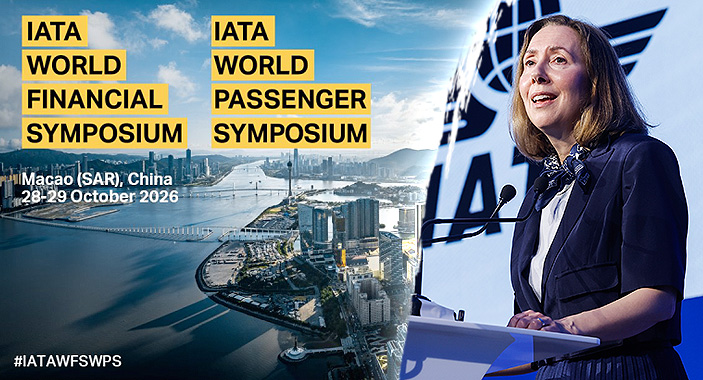
On Wednesday, October 28, 2026, the International Air Transport Association (IATA) launched its World Financial Symposium (WFS) & World Passenger Symposium (WPS) in Macao (SAR), China. Read More » In the opening speech, Sandrine Le Borgne, IATA Interim Director General, CFO and Senior Vice President, Corporate Services, highlighted the challenge of turning advances in digitalization across airline retailing, payments, and digital identity into even better passenger journeys and a more efficient, financially resilient industry.
The gathering takes place at a time IATA described as volatile. “2026 has been a year of intense volatility. Conflicts have closed some airspace and disrupted many routes. Fuel prices have risen sharply. And aerospace supply chains are still not back to normal. Every CEO, CFO, commercial, and operations leader in this room is having to make decisions in a way more volatile world,” Le Borgne said. “And you must manage on very-thin margins. Airlines carry more than five billion passengers a year and are expected to earn just US$4.50 per passenger in 2026, which a net margin of around only 2%. A small rise in costs or fall in demand can turn profit into loss. You are being asked to deliver two things at the same time: #1 protect today’s results and #2 build tomorrow’s solutions that will make your airlines successful in the years to come,” she added.
The IATA CFO stressed that leveraging new technology is an important part of this challenge. She pointed out that many of the new solutions the industry has talked about for years have moved from concept to reality. “Today, a traveler can use AI to plan a trip. They can pay with a digital wallet and use biometrics for a more seamless journey at the airport. The challenge now is realizing the value that these innovations can create to make travel more efficient and improve financial resilience,” she said.
“The challenge now is realizing the value these technologies create. This is why the theme of our conference is: From Vision to Value,” said Le Borgne.
One of the main issues industry leaders discussed at the event was how to prepare the marketplace for the future. “AI assistants and automated agents are changing how travelers discover and compare travel. For airlines, this creates both opportunity and risk. The strategic opportunity for airlines is to prepare for this shift while retaining control of their data, retaining control of their commercial relationships, and ensuring the underlying quality of data,” said IATA.
Modern Airline Retailing is central to adapting to this changing marketplace, and the transition is already under way. Seven airlines are live or implementing Orders, with more than 20 expected to follow from 2027, while IT providers have committed more than US$1.7 billion to Offers and Orders. “Offers and Orders are the foundation; AI is the accelerator. They need to move forward together as AI increasingly reshapes how travel is discovered, sold, and serviced,” said Le Borgne.
Another focus is put on strengthening financial sustainability. IATA called for a holistic view of financial functions as part of the industry’s investments in digitalization. “New payment methods taking advantage of digitalization can increase customer choice, but also affect cost, cash flow, and risk. With airlines spending more than US$24.5 billion annually to process payments, these effects must be considered together,” said the Association. In Offers and Orders, reconciliation, settlement, and revenue accounting must be built into the transformation from the start to remove complexity rather than simply digitize it, IATA added.
The third pillar of the discussion will address making travel easier. IATA says biometrics are increasingly part of the normal travel experience, making airport processing faster and smoother. But as many solutions are airport- or country-specific, the value they can potentially create for passengers and airlines is not fully realized. “The industry’s answer is One ID: confirm your identity once, and be recognized throughout the journey,” Le Borgne said. “But One ID can only go so far on its own. A seamless journey across borders depends on governments trusting and accepting the underlying digital identity,” she added. Standards for secure digital passports exist in ICAO’s Digital Travel Credential. Passenger expectations are high, with more than eight in ten passengers saying they are interested in using a digital passport to check in. The challenge for wider adoption is getting governments to issue and accept digital travel credentials.
IATA said it is important that the event is held in Macau, adding that the 2026 WFS & WPS mark the first time the events have been held in North Asia, reflecting the region’s leading role in digital innovation. China’s airlines carried more than 770 million passengers in 2025, a record high, with significant potential for further growth. Capturing that opportunity will require continued investment, particularly in technology that can support growth while making travel simpler, more efficient, and more sustainable. China’s leadership is not only about scale. It has also led digital innovation, changing how people shop, pay, and travel. As we learn from one another, we must keep our solutions connected. We do this by having one set of global standards and evolving them as technology advances. That is how we turn regional progress into a better experience for passengers worldwide,” said Le Borgne.
IATA’s 2026 Global Passenger Survey shows Asia-Pacific travelers are among the most satisfied airline passengers
According to the International Air Transport Association’s (IATA) Global Passenger Survey (GPS), 90% of Asia-Pacific travelers are overall satisfied with air travel, making them the most satisfied regional group, along with passengers from the Middle East. The passengers from our region are the second most willing of any region to use biometrics, although they expressed strong concerns about data breaches. They are the highest adopters of electronic bag tags among all the regions (56% vs. 42% globally). 49% of passengers from Asia-Pacific said immigration requirements discourage them from traveling. Passengers from our region are the most likely globally to be discouraged from travel by geopolitical issues (62% vs. 59%), and have the strongest safety concerns (77% vs. 72%).
Globally, GPS highlighted three major trends in passenger behavior and expectations: Passengers are embracing biometric identification to reduce repeated document checks, show strong interest in using digital passports for check-in, and want more personalized services at booking. From finding flights and comparing fares to discovering their next destination, passengers are making AI part of their travel planning. More passengers say immigration requirements have discouraged them from visiting a destination.
“Passengers are embracing technology to make travel easier. AI is becoming a mainstream travel-planning tool, while biometrics and digital identity are creating a faster, more seamless airport experience. Yet many travelers continue to face barriers from complex immigration and visa processes. Governments can help by simplifying entry requirements, eliminating duplicate checks, and accelerating the issuance and acceptance of secure digital travel credentials,” said Nick Careen, IATA’s Senior Vice President, Operations, Safety and Security.
This year’s GPS results showed biometrics moving mainstream, with over half of passengers (58%) reporting they used biometrics at some point in their airport journey in the past 12 months, up from 50% in 2025. Passengers also show strong interest in using digital passports to simplify their journeys. “More passengers are experiencing biometrics during their travels. They like it and want more. That’s good news because the benefits are substantial— smoother journeys for passengers and more efficient, secure processes for governments and airlines. To make biometrics the norm for international travel, governments must agree on a framework for issuing and accepting secure digital passports—or Digital Travel Credentials,” said Careen.
At the same time, the GPS shows that entry requirements are a growing barrier to travel, even as passengers embrace technology. Immigration requirements have discouraged 43% of passengers from visiting a destination, up from 33% in 2025. “Passengers want to apply for visas online and complete immigration procedures before they reach the airport. eVisas can deliver that, but airlines can only verify them efficiently if governments use common standards. More than 100 countries issue eVisas, yet there is little consistency in how they are checked. The tools to fix that already exist, and governments should adopt them,” said Careen.
Air New Zealand and Hong Kong Airport make history by being first to achieve IATA One ID Certification
The International Air Transport Association (IATA) announced that Air New Zealand (Air NZ) and Hong Kong International Airport (HKIA) are the first organizations to achieve One ID Certification. IATA presented the certifications at the IATA World Passenger Symposium (WPS) in Macao.
One ID is a set of global industry standards for using digital identity and biometrics across the passenger journey. These support a journey where passengers confirm their identity and travel documents before reaching the airport, then pass through checkpoints using facial recognition instead of repeatedly showing their passport and boarding pass. “Digital identity can make travel much simpler for passengers, but only if everyone involved in the journey trusts how others verify identity, handle biometric data, and protect privacy. One ID Certification gives them that assurance. Air New Zealand and Hong Kong International Airport are among the industry’s leaders in using One ID-enabled digital identity to improve the passenger experience. As the first organizations to be certified, they have set the benchmark for others to follow,” said Nick Careen, IATA’s Senior Vice President, Operations, Safety and Security. Organizations can be certified in one or more of four areas of activity: Digitalization of Admissibility, Contactless Travel, Biometric Handling, and Privacy, Consent, and Governance. Airlines, airports, and technology providers can pursue certification. As the first organizations to achieve One ID Certification, Air New Zealand and Hong Kong International Airport were certified across all areas applicable to their respective operations.
“Flight Token, Hong Kong International Airport’s self-service biometric identification system, has transformed the departure journey by enabling passengers to travel through key airport checkpoints using facial recognition. Today, more than 80% of departing passengers at HKIA are eligible to use Flight Token across all checkpoints of the departure journey. Since its launch in 2021, more than 93 million passengers have used Flight Token to date. Achieving One ID Certification confirms that HKIA’s digital identity and biometric processes align with IATA’s global standards. As we work with airlines, airports, and government authorities to expand Flight Token beyond Hong Kong, this certification provides a trusted foundation for interoperable and seamless digital travel,” said Vivian Cheung, Chief Executive Officer of Airport Authority Hong Kong.
Air New Zealand has a proud history of innovation and problem-solving, and we always start with our customer and what’s going to make things easier. Our trial with Hong Kong International Airport showed how digital identity could work across borders, reducing the need for documentation and queuing, but it also showed that customers can trust us to keep their information safe. The certification recognizes the work we’ve done to date and the importance we place on protecting our customers’ personal information as we explore new ways to improve the travel experience over time,” said Jeremy O’Brien, Chief Customer & Digital Officer, Air New Zealand.

