
IATA WFS&WPS: News Coverage
IATA WFS&WPS 2026 concludes with sense of achievement and anxiety
October 30th 2026
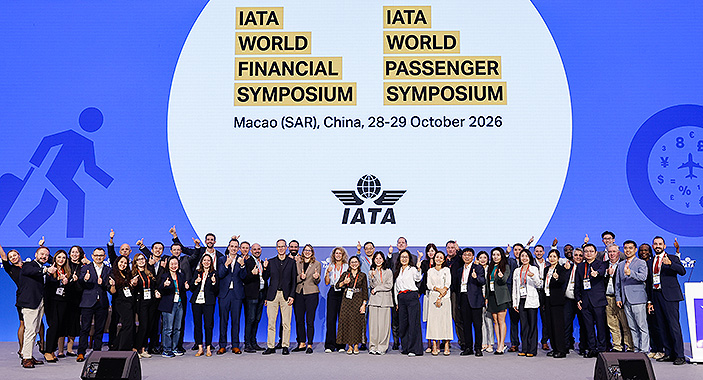
On October 29, 2026, the International Air Transport Association (IATA) successfully concluded its World Financial Symposium (WFS) & World Passenger Symposium (WPS) held in Macao (SAR), China. Read More »
Delegates at this year’s event witnessed the announcement that Air New Zealand (Air NZ) and Hong Kong International Airport (HKIA) are the first organizations to achieve One ID Certification. For many, the occasion marked a historic milestone, turning a vision set a decade ago into reality. “The challenge now is realizing the value these technologies create. This is why the theme of our conference is: From Vision to Value,” Sandrine Le Borgne, IATA Interim Director General, CFO and Senior Vice President, Corporate Services, said in her opening address, setting the tone for the event. After concluding the period of “foundations”, the industry roadmap set by IATA expects the airline industry to enter the period of scaling up until the end of the decade, followed by the period of the industry at scale from 2030-2035+. The non-binding dates reflect the expected direction of development.
As is usual at IATA global events, delegates felt that collaborating and sharing experiences is the best way for the industry to move forward. Holding this year’s edition in Macao provided an opportunity to build meaningful connections with the Chinese airline industry. Last year, its airlines carried more than 770 million passengers, setting a new record. The country has also led digital innovation, changing how people shop, pay, and travel. Together, these developments mean the experiences Chinese players shared during the event offered a valuable lesson, and presentations such as “Shaping the Future of Travel Through Innovation and Connectivity” by Bo Jiang, Chairman of TravelSky Holding, were well received.
Much of the focus and discussion at this year’s WFS&WPS centered on the rapid development of Augmented Artificial Intelligence (AI) and its effects on the industry, which cannot be predicted at this time. IATA’s 2026 Global Passenger Survey results, announced during the event, show that AI is changing how passengers plan travel, from finding flights and comparing fares to discovering their next destination. This has many industry professionals anticipating scenarios in which AI agents buy tickets on users’ behalf, and how this will change the current retail environment. Delegates largely agreed that, for now, no one can predict which direction AI’s rapid development will take, and that its progress must be closely monitored. Some delegates shared the view that, for some players, the coming change might have existential consequences. This left many wondering what the industry will look like by the next edition of WFS&WPS.
The 2027 World Financial Symposium (WFS) & World Passenger Symposium (WPS) will be held October 27-28 in Dubai, hosted by Emirates Airlines.
Chinese aviation leaders offer lessons for global industry on aviation transformation
The International Air Transport Association (IATA) World Financial Symposium (WFS) & World Passenger Symposium (WPS) were held in Macao (SAR), China, giving Chinese industry leaders a chance to share their experiences with delegates from around the world. The lesson was especially valuable not only because China is on track to become the world’s largest aviation market by 2029, but also because its industry is currently shifting from rapid expansion to high-quality growth.
“I consider myself fortunate to have worked in this industry for 20 years and to have experienced what I would describe as the golden age of Chinese civil aviation. From approximately 2010 to 2019, following the global financial crisis, China experienced extraordinary aviation growth. Even today, we frequently compare our performance with 2019, demonstrating just how exceptional that period was,” said Nan Hu, Senior Vice President, Commercial Steering Committee, Xiamen Airlines. “But looking ahead over the next five to ten years, I believe Chinese aviation will follow the broader Chinese economy in transitioning from high-speed expansion to high-quality development. For airlines, this means that although our scale may continue to grow, our unit revenues and cost structures face enormous challenges,” he added. At the same time, he sees three favorable long-term trends for China’s industry: the international expansion of Chinese businesses, especially to markets such as Africa; inbound tourism and international travel (in 2025, China received approximately 150 million inbound visitors, exceeding pre-pandemic levels); and China’s aging population (China now has more than 300 million people aged over 60, and over the next five to ten years, older travelers will become an increasingly important customer segment for Chinese airlines).
At the same time, Mainland airlines face major international challenges, including geopolitical tensions, fuel prices, and supply chain constraints. Chinese airlines also face two additional pressures: intense domestic price competition and competition from high-speed rail. Last year, high-speed rail carried approximately six times as many passengers as Chinese aviation. With trains operating at around 300 km/h, airlines already struggle to compete on routes shorter than 1,000 kilometers. Future railway technology, including the CR450 train, could increase operating speeds to 350 km/h. That could extend high-speed rail’s competitive reach to routes of around 1,200 kilometers, further squeezing airline margins.
Dr. Xingquan Xie, IATA’s Regional Vice President for North Asia, noted that passenger expectations are rising. Travelers increasingly want seamless journeys, including seamless border clearance. Last year, 58% of passengers had used biometric technology, 78% were willing to use it, and 82% wanted to manage their entire journey through their smartphones.
This year, China Eastern Airlines (CEA) performed One ID travel between Shanghai Hongqiao International Airport and Macau, showcasing the promise of the new technology. By 2030, the country wants to introduce paperless and biometric clearance for major international flights. By 2035, it will be fully paperless and biometric for domestic and international flights.
At the same time, Chinese civil aviation is undergoing a fundamental shift from individual player efficiency, such as airports, to an interconnected ecosystem. Stanley Pun, President of the Civil Aviation Authority of Macao, China, presented a clear example of this approach in his welcome speech to the WFS&WPS delegates, outlining the policy shaping aviation’s future in the Greater Bay Area (GBA).
Asia, North Asia are in the centre of airline industry digitalization says IATA
During the International Air Transport Association (IATA) World Financial Symposium (WFS) & World Passenger Symposium (WPS) held on October 28-29, 2026, in Macao (SAR), China the leaders of the Association renewed the message that Asia, and China are central to the digitalization of the airline industry.
“China’s leadership is not only about scale. It has also been at the forefront of digital innovation, changing how people shop, pay, and travel,” Sandrine Le Borgne, IATA’s Interim Director General, CFO & SVP Corporate Services told in her WFS&WPS opening speech.
“Historically Asia and North Asia has been very innovative. Projected high volumes are center to the global perspective. The passengers from this region are wanting more digitalization. So if you add those elements, innovation and projected volumes, and the fact that the appetite for technology is very high compared to some other parts of the world, this all puts Asia in the center of digital transformation,” she told Orient Aviation Daily Digest.
Nick Careen, IATA’s Senior Vice President, Operations, Safety and Security, believes that North Asia already made a transition from vision to value, that the rest of the world should take a note of. “It is fascinating of what is happening in this part of the world in the last 20 years. Airlines have been around for a long time. In the western world, they have evolved differently because in the way the things just naturally were. This part of the world adapt digitalization much faster, because they started at much later point. So rapid growth in last 20 years, here compared to the slow moving monolith in western world. We can move how things are done, for example the use of apps in this part of the world for all services, versus what’s available in the others parts of the world. Value is already here, and the rest of the world is about to learn quickly how learn leverage from learning what is being done here,” he told Orient Aviation Daily Digest.
Citi lists six cost and risk challenges to monitor in 2027
The current decade in airline industry finances can be summarized as a “Decade of Shocks”, Darren Brighton, Managing Director and Global Head of Digital FX Sales at Citi, told delegates of the International Air Transport Association (IATA) World Financial Symposium (WFS) & World Passenger Symposium (WPS) in Macao (SAR), China, on October 28, 2026. He said the airlines need to monitor six persistent cost and risk challenges.
Cost of capital affects rates, yields, and the cost of new aircraft. On September 16, 2026, Fed Funds hiked to 4.00%. The USD funding weight affects Finance & Treasury decisions, raising the cost of debt (EETC spreads widened since August 2026) and narrowing the refi window (24% of airline debt due within the next 12 months; Asia-Pacific has the highest proportion at 37%). Post-refi, higher interest payments could reduce cash for deleveraging, fleet renewal & decarbonization, Brighton noted.
Supply chain issues are delaying growth, with the current backlog reaching 60% of the active fleet. An older fleet means higher costs: High MRO & fuel burn per seat amplify the impact of fuel shocks.
FX & USD exposure can be a positive element for some airlines, with USD being broadly forecast to weaken. It opens opportunity to reduce downside risk while retaining participation in USD weakness.
Fuel volatility remains, with geopolitics still uncertain. Brighton noted that refining capacity takes time to rebuild, with Qatan LNG estimated at 3-5 years.
Airspace closures and rerouting, amid uncertain geopolitics, continue to weigh on growth and route expansion plans. The closure of Russian airspace on some Europe-Asia routes added up to 4 hours to flight times.
The final element affecting airline finances is carbon compliance. The EU ETS allowance system was launched in 2026, while CORSIA compliance starts in 2027.

