
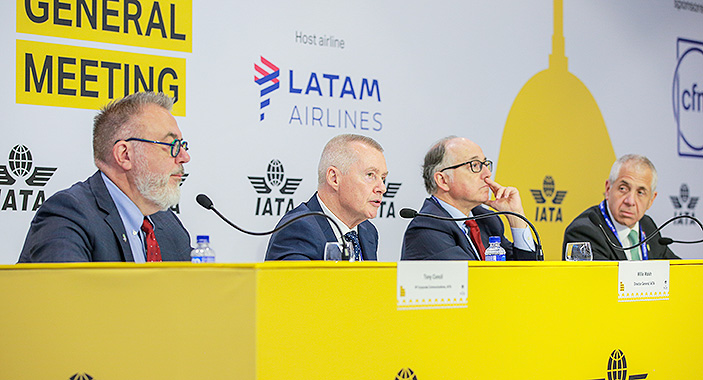
82nd IATA AGM and WATS: News Coverage
IATA reduces profitability expectations in the latest outlook published after the start of Middle East conflict
June 8th 2026
The airlines’ profitability will be half as low as previously anticipated, the International Air Transport Association (IATA) said in its latest financial outlook, published during the IATA 82nd Annual General Meeting (AGM) & World Air Transport Summit (WATS) in Rio de Janeiro, Brazil, hosted by LATAM Airlines Group. Read More » The document takes into consideration the consequences of the war-related Middle East disruptions and high fuel prices. “The regional landscape, however, is highly differentiated. At the geographic center of the Middle East war, airlines in the Middle East are expected to collectively fall into the red with weak demand and operational disruptions. All other regions are expected to deliver profits, but at reduced levels from previous projections,” the global association said.
Airlines are expected to achieve a combined net profit of $23.0 billion in 2026, roughly half the previously projected $41 billion. It is also roughly half the $45 billion net profit estimate for 2025, while the net profit margin is expected to be 2.0% in 2026, roughly half the previously projected 3.9%. It is also less than half the 4.2% estimate for the 2025 net profit margin. Net profit per passenger transported is expected to be $4.50, half the $9.10 achieved in 2025.
Operating profit in 2026 is expected to be $48.0 billion (down from $76.4 billion in 2025) for a net operating margin of 4.1% (down from 7.2% in 2025).
On the operational side, passenger numbers are expected to reach 5.1 billion in 2026 (up 2.4% on 2025). The passenger load factor is forecast to continue to set record highs, with airlines expected to fill 84.0% of all seats over the year. That is an improvement on 83.5% in 2025. Cargo volumes are expected to reach 71.7 million tonnes in 2026 (up 0.2% on 2025).
Asia-Pacific airlines are projected to achieve $6.6 billion in profit in 2026, compared to $9.8 billion in 2025. Net margins are expected to drop to 2.1% this year, down from 3.5% in 2025. Profit per passenger will reach $3.4, dropping from $5.3 in 2025. On the operational side, the IATA predicts that demand (RPK) in 2026 will increase by 5.1% (compared to 7.7% in 2025). The capacity in the region will increase by 3.6% (compared to 6.6% in 2025). “The Asia Pacific region relies heavily on crude oil imports from the Gulf, and the lack of such supplies can cause more acute pressure on refineries and create jet fuel shortages as well as higher jet fuel prices than in other regions. This environment is already prompting capacity adjustments, and longer routings, caused by airspace restrictions, lead to increased fuel burn, tighter effective capacity, and higher unit costs,” the IATA said.
“Demand fundamentals remain supportive with both domestic and international passenger traffic continuing to grow. In fact, some Asia Pacific carriers are benefiting from shifting traffic flows linked to the Middle East conflict, particularly on Europe–Asia routes. Cost pressures are amplified by the depreciation of several Asian currencies, which raises the local currency cost of US dollar-denominated expenses, most notably fuel,” IATA commented. “Disruptions at Middle Eastern hubs have created additional opportunities for Asia-based carriers to capture cargo traffic, particularly on Europe–Asia trade lanes. However, regulatory changes in Europe, including tighter customs requirements for low-value shipments, may weigh on e-commerce volumes. Overall, while cargo growth is likely to moderate, capacity constraints and rerouting effects should keep market conditions relatively tight,” the IATA outlook said.
“War-related disruptions in the Middle East and rising fuel costs have shifted the outlook for airlines to the worse. Globally, airlines are expected to see profitability halve compared to 2025. Profits will shrink from $45 billion in 2025 to $23 billion this year. And margins will shrink from 4.2% to 2.0%. All airline bottom lines are suffering from the rapid 70% rise in jet fuel prices. Some of the additional cost is being recuperated by adjusting prices and improving efficiency, but it will not be sufficient to maintain profitability at the previous year’s level,” said Willie Walsh, IATA’s Director General.
“At the regional level, all are in the black but with sharply reduced financial performance, with the exception of the Middle East,” he added. During the meeting with the media, Walsh said that he does not view the current situation as a crisis, highlighting the fact that the industry will still be making a profit. It does not mean that all airlines will be profitable. “Smaller carriers that started the year with weak balance sheets are certainly struggling,” he said.
China led international passenger growth in 2025
In 2025, China achieved the 17.5% growth of international passengers, the highest figure among top 10 markets, said Dr Xie Xingquan, the International Air Transport Association (IATA) Regional Vice President, North President, during his presentation at the The IATA 82nd Annual General Meeting (AGM) & World Air Transport Summit (WATS) in Rio de Janeiro, Brazil, hosted by LATAM Airlines Group. The country’s share in the global domestic RPK market reached 30%. As of the end of 2025, there were 249 airports with regular scheduled flights in China and 4,574 registered aircraft.
In the view of the IATA, the biggest opportunities for the market are the steady demand, boosted by the fact that 900 million people in China have never flown on an airplane, and the strong trend of inbound international passengers - in 2025, the number of international visitors to China reached 35.2 million, up 30.5% compared to a year earlier. Another opportunity is presented by digitalization and the commercial introduction of the domestic aircraft, the COMAC C919.
Currently, the biggest challenges China’s carriers face are intensifying competition from high-speed rail, which has firmly established itself in the short-distance market of 800 kilometers or less, and a low-yield environment. In China, in 2025, air transport revenue stood at $0.7 per km, a 4.9% year-on-year decrease. The supply chain issue means the average age of China’s fleets has reached around 10 years. Since 2020, the number of aircraft aged 20 years or older has exceeded new aircraft deliveries.
Asia-Pacific carriers can expect 2.4 billion additional passengers over next two decades
In 2044, Asia-Pacific airlines will fly 4.1 billion passengers annually, compared to 1.7 billion passengers flown in 2024, Sheldon Hee, the International Air Transport Association (IATA) Regional Vice President, Asia Pacific, told the media during the IATA 82nd Annual General Meeting (AGM) & World Air Transport Summit (WATS) in Rio de Janeiro, Brazil, hosted by LATAM Airlines Group. To accommodate this trend, several markets in the region are developing mega airports. Industry forecasts predict over $2.4 trillion of airport capex by 2040, over half in Asia-Pacific, to address capacity constraints and congestion. This involves extending existing airports, such as Singapore Changi and Delhi, as well as creating new greenfield projects, such as New Manila and Long Thah. Other challenges the industry in the region needs to address include taxation, over-regulation, and sustainable growth. States should reduce, and ultimately eliminate, taxes on the sale and use of international transport, Hee said.
Philippine Airlines to join oneworld alliance
Philippine Airlines (PAL) has accepted the oneworld alliance’s invitation to become its 16th member airline, the carrier and alliance representatives announced during the joint media event at the International Air Transport Association (IATA) 82nd Annual General Meeting (AGM) & World Air Transport Summit (WATS) in Rio de Janeiro, Brazil, hosted by LATAM Airlines Group. It is expected that PAL will complete an integration process and become a member in 2027. “This is a defining and transformative moment for Philippine Airlines. Becoming a member of the oneworld Alliance and strengthening Southeast Asia’s representation within the group significantly brings the Philippines and the region closer to the world like never before. Together with our partners, we will deliver greater choice, consistent journeys, and a world-class travel experience that reflects the warmth of Filipino hospitality,” said PAL Holdings, Inc. President Lucio C. Tan III. PAL’s entry into oneworld supports our long-term strategic growth and strengthens our connectivity across key markets in the Asia Pacific region. The airline has a proud heritage and will serve a critical role in our Southeast Asia network,” Robert Isom, American Airlines Chief Executive Officer and chairman of the oneworld Governing Board, commented. “Philippine Airlines is a globally respected carrier with a strong commitment to innovation and customer service that aligns with oneworld’s reputation for delivering a premium experience across the travel journey. This decision is an endorsement of oneworld, and its global customer offering. We look forward to welcoming Philippine Airlines into the alliance,” said Ole Orvér, Oneworld CEO. Speaking at a media briefing the following day, he explained that, geopolitically, PAL fits perfectly within the alliance and highlighted the importance of the Asia-Pacific region. Orvér also added that while working on integrating PAL into Oneworld, the alliance might not be active in pursuing other members. Instead, it may enter into partnerships with strategic operators, such as hotel chains, just as it did with the hospitality brand Indian Hotels Company (IHCL).
Xiamen Airlines announced as a host of 83rd IATA AGM
The International Air Transport Association (IATA) announced that Xiamen Airlines will host the 83rd IATA Annual General Meeting (AGM) and World Air Transport Summit (WATS) in Xiamen, China, from 30 May to 1 June 2027. “We are excited to bring the 83rd IATA AGM to China, hosted by Xiamen Airlines. China is a major player in the aviation industry. China’s airlines are among the top in the world by passenger traffic. And the country is at the forefront of deploying technology and digitalization to improve efficiency. Hosting the AGM in China will allow the leaders of the global aviation industry to witness first-hand the impressive development of the China market,” said Willie Walsh, IATA’s Director General. “Xiamen Airlines is proud to host the IATA AGM and to welcome our industry colleagues to our home base of Xiamen. China is a vast and culturally diverse country, with many dynamic cities and regions beyond its best-known gateways. Located on China’s southeast coast, Xiamen is an historical port and interface for commerce between China and the rest of the world,” said Zhao Dong, Chairman of Xiamen Airlines. “The opening of Xiang’an International Airport later this year demonstrates how Xiamen is growing its importance as a transportation and business hub. AGM guests can look forward to discovering the rich culture, warm hospitality, coastal beauty, and a relaxed lifestyle that create the distinctive spirit and vitality of Xiamen,” Xie Bing, CEO & President of Xiamen Airlines, commented.
On October 14-15, 2025, Xiamen Airlines was the host of the IATA’s World Safety and Operations Conference (WSOC). The event was praised by the attendees for the high organizational level and the opportunity to learn from the Chinese peers’ experience in such fields as digitalization and the use of new technologies, named in China as “smart aviation”.

